


EllieKini/Herta
Audio-to-Audio • Updated
text stringlengths 0 2k | heading1 stringlengths 3 79 | source_page_url stringclasses 189
values | source_page_title stringclasses 189
values |
|---|---|---|---|
`gradio-rs` is a Gradio Client in Rust built by
[@JacobLinCool](https://github.com/JacobLinCool). You can find the repo
[here](https://github.com/JacobLinCool/gradio-rs), and more in depth API
documentation [here](https://docs.rs/gradio/latest/gradio/).
| Introduction | https://gradio.app/docs/third-party-clients/rust-client | Third Party Clients - Rust Client Docs |
Here is an example of using BS-RoFormer model to separate vocals and
background music from an audio file.
use gradio::{PredictionInput, Client, ClientOptions};
[tokio::main]
async fn main() {
if std::env::args().len() < 2 {
println!("Please provide an audio file path as a... | Usage | https://gradio.app/docs/third-party-clients/rust-client | Third Party Clients - Rust Client Docs |
cargo install gradio
gr --help
Take [stabilityai/stable-
diffusion-3-medium](https://huggingface.co/spaces/stabilityai/stable-
diffusion-3-medium) HF Space as an example:
> gr list stabilityai/stable-diffusion-3-medium
API Spec for stabilityai/stable-diffusion-3-medium:
/infer
... | Command Line Interface | https://gradio.app/docs/third-party-clients/rust-client | Third Party Clients - Rust Client Docs |
Gradio applications support programmatic requests from many environments:
* The [Python Client](/docs/python-client): `gradio-client` allows you to make requests from Python environments.
* The [JavaScript Client](/docs/js-client): `@gradio/client` allows you to make requests in TypeScript from the browser or serv... | Gradio Clients | https://gradio.app/docs/third-party-clients/introduction | Third Party Clients - Introduction Docs |
We also encourage the development and use of third party clients built by
the community:
* [Rust Client](/docs/third-party-clients/rust-client): `gradio-rs` built by [@JacobLinCool](https://github.com/JacobLinCool) allows you to make requests in Rust.
* [Powershell Client](https://github.com/rrg92/powershai): `pow... | Community Clients | https://gradio.app/docs/third-party-clients/introduction | Third Party Clients - Introduction Docs |
ZeroGPU
ZeroGPU spaces are rate-limited to ensure that a single user does not hog all
of the available GPUs. The limit is controlled by a special token that the
Hugging Face Hub infrastructure adds to all incoming requests to Spaces. This
token is a request header called `X-IP-Token` and its value changes depending
on... | Explaining Rate Limits for | https://gradio.app/docs/python-client/using-zero-gpu-spaces | Python Client - Using Zero Gpu Spaces Docs |
Token
In the following hypothetical example, when a user presses enter in the
textbox, the `generate()` function is called, which calls a second function,
`text_to_image()`. Because the Gradio Client is being instantiated indirectly,
in `text_to_image()`, we will need to extract their token from the `X-IP-
Token` head... | Avoiding Rate Limits by Manually Passing an IP | https://gradio.app/docs/python-client/using-zero-gpu-spaces | Python Client - Using Zero Gpu Spaces Docs |
The main Client class for the Python client. This class is used to connect
to a remote Gradio app and call its API endpoints.
| Description | https://gradio.app/docs/python-client/client | Python Client - Client Docs |
from gradio_client import Client
client = Client("abidlabs/whisper-large-v2") connecting to a Hugging Face Space
client.predict("test.mp4", api_name="/predict")
>> What a nice recording! returns the result of the remote API call
client = Client("https://bec81a83-5b5c-471e.gradio.live") conne... | Example usage | https://gradio.app/docs/python-client/client | Python Client - Client Docs |
Parameters ▼
src: str
either the name of the Hugging Face Space to load, (e.g. "abidlabs/whisper-
large-v2") or the full URL (including "http" or "https") of the hosted Gradio
app to load (e.g. "http://mydomain.com/app" or
"https://bec81a83-5b5c-471e.gradio.live/").
token: str | None
d... | Initialization | https://gradio.app/docs/python-client/client | Python Client - Client Docs |
n the remote machine instead.
ssl_verify: bool
default `= True`
if False, skips certificate validation which allows the client to connect to
Gradio apps that are using self-signed certificates.
analytics_enabled: bool
default `= True`
Whether to allow basic telemetry. If None, will u... | Initialization | https://gradio.app/docs/python-client/client | Python Client - Client Docs |
Description
Event listeners allow you to respond to user interactions with the UI
components you've defined in a Gradio Blocks app. When a user interacts with
an element, such as changing a slider value or uploading an image, a function
is called.
Supported Event Listeners
The Client component supports the following... | Event Listeners | https://gradio.app/docs/python-client/client | Python Client - Client Docs |
eters. For hardware upgrades (beyond the basic
CPU tier), you may be required to provide billing information on Hugging Face:
<https://huggingface.co/settings/billing> <br>
Event Parameters
Parameters ▼
args: <class 'inspect._empty'>
The positional arguments to pass to the remote API endpoint. The or... | Event Listeners | https://gradio.app/docs/python-client/client | Python Client - Client Docs |
**Stream From a Gradio app in 5 lines**
Use the `submit` method to get a job you can iterate over.
In python:
from gradio_client import Client
client = Client("gradio/llm_stream")
for result in client.submit("What's the best UI framework in Python?"):
print(result)
... | Ergonomic API 💆 | https://gradio.app/docs/python-client/version-1-release | Python Client - Version 1 Release Docs |
Anything you can do in the UI, you can do with the client:
* 🔐Authentication
* 🛑 Job Cancelling
* ℹ️ Access Queue Position and API
* 📕 View the API information
Here's an example showing how to display the queue position of a pending job:
from gradio_client import Client
client = ... | Transparent Design 🪟 | https://gradio.app/docs/python-client/version-1-release | Python Client - Version 1 Release Docs |
The client can run from pretty much any python and javascript environment
(node, deno, the browser, Service Workers).
Here's an example using the client from a Flask server using gevent:
from gevent import monkey
monkey.patch_all()
from gradio_client import Client
from flask import Fla... | Portable Design ⛺️ | https://gradio.app/docs/python-client/version-1-release | Python Client - Version 1 Release Docs |
Changes
**Python**
* The `serialize` argument of the `Client` class was removed and has no effect.
* The `upload_files` argument of the `Client` was removed.
* All filepaths must be wrapped in the `handle_file` method. For example, `caption = client.predict(handle_file('./dog.jpg'))`.
* The `output_dir` a... | v1.0 Migration Guide and Breaking | https://gradio.app/docs/python-client/version-1-release | Python Client - Version 1 Release Docs |
A Job is a wrapper over the Future class that represents a prediction call
that has been submitted by the Gradio client. This class is not meant to be
instantiated directly, but rather is created by the Client.submit() method.
A Job object includes methods to get the status of the prediction call, as
well to get the ... | Description | https://gradio.app/docs/python-client/job | Python Client - Job Docs |
Parameters ▼
future: Future
The future object that represents the prediction call, created by the
Client.submit() method
communicator: Communicator | None
default `= None`
The communicator object that is used to communicate between the client and the
background thread running the job
... | Initialization | https://gradio.app/docs/python-client/job | Python Client - Job Docs |
Description
Event listeners allow you to respond to user interactions with the UI
components you've defined in a Gradio Blocks app. When a user interacts with
an element, such as changing a slider value or uploading an image, a function
is called.
Supported Event Listeners
The Job component supports the following ev... | Event Listeners | https://gradio.app/docs/python-client/job | Python Client - Job Docs |
If you already have a recent version of `gradio`, then the `gradio_client` is
included as a dependency. But note that this documentation reflects the latest
version of the `gradio_client`, so upgrade if you’re not sure!
The lightweight `gradio_client` package can be installed from pip (or pip3)
and is tested to work w... | Installation | https://gradio.app/docs/python-client/introduction | Python Client - Introduction Docs |
Spaces
Start by connecting instantiating a `Client` object and connecting it to a
Gradio app that is running on Hugging Face Spaces.
from gradio_client import Client
client = Client("abidlabs/en2fr") a Space that translates from English to French
You can also connect to private Spaces by pass... | Connecting to a Gradio App on Hugging Face | https://gradio.app/docs/python-client/introduction | Python Client - Introduction Docs |
use
While you can use any public Space as an API, you may get rate limited by
Hugging Face if you make too many requests. For unlimited usage of a Space,
simply duplicate the Space to create a private Space, and then use it to make
as many requests as you’d like!
The `gradio_client` includes a class method: `Client.d... | Duplicating a Space for private | https://gradio.app/docs/python-client/introduction | Python Client - Introduction Docs |
app
If your app is running somewhere else, just provide the full URL instead,
including the “http://” or “https://“. Here’s an example of making predictions
to a Gradio app that is running on a share URL:
from gradio_client import Client
client = Client("https://bec81a83-5b5c-471e.gradio.live")... | Connecting a general Gradio | https://gradio.app/docs/python-client/introduction | Python Client - Introduction Docs |
Once you have connected to a Gradio app, you can view the APIs that are
available to you by calling the `Client.view_api()` method. For the Whisper
Space, we see the following:
Client.predict() Usage Info
---------------------------
Named API endpoints: 1
- predict(audio, api_name="/pre... | Inspecting the API endpoints | https://gradio.app/docs/python-client/introduction | Python Client - Introduction Docs |
As an alternative to running the `.view_api()` method, you can click on the
“Use via API” link in the footer of the Gradio app, which shows us the same
information, along with example usage.
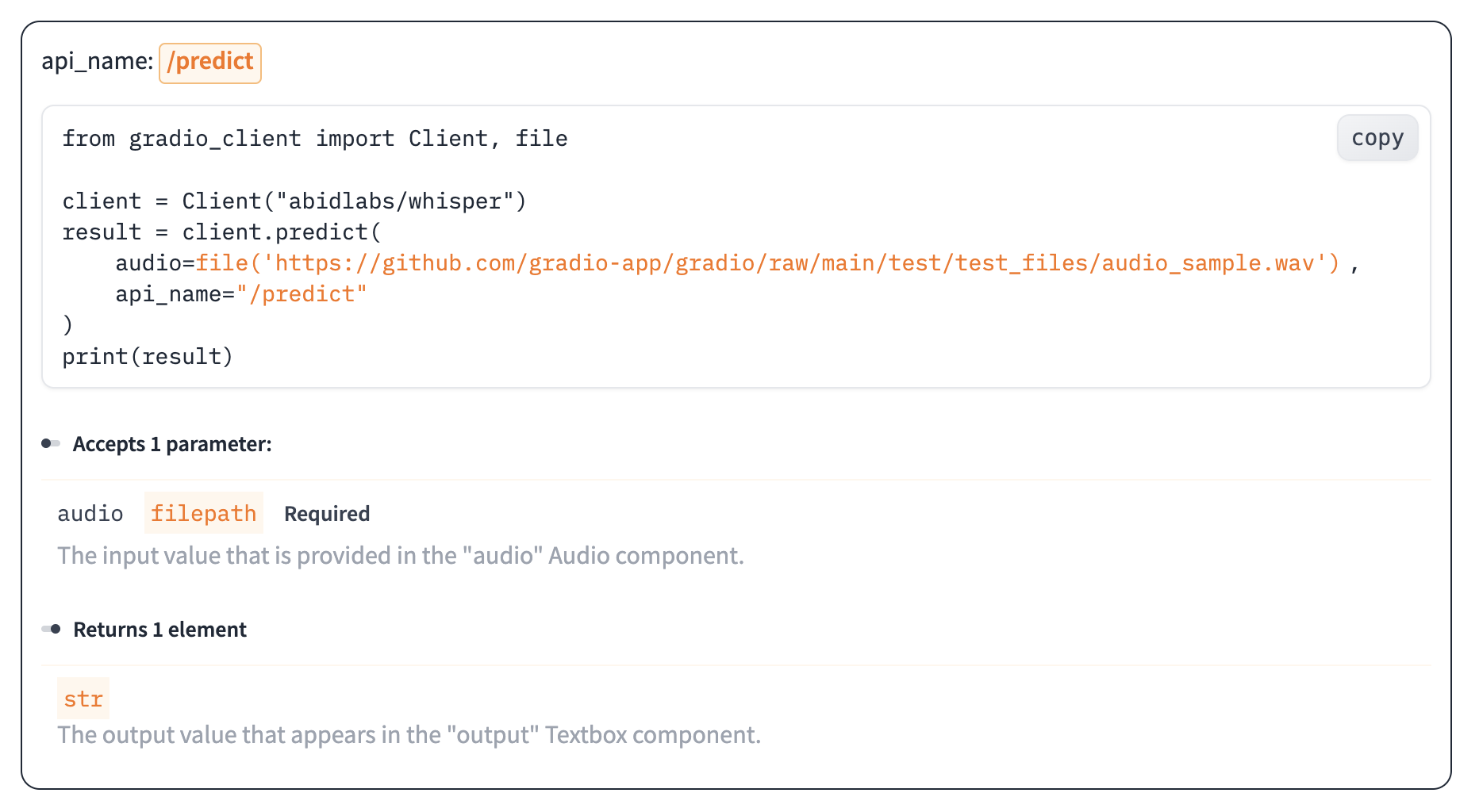
The View API pag... | The “View API” Page | https://gradio.app/docs/python-client/introduction | Python Client - Introduction Docs |
The simplest way to make a prediction is simply to call the `.predict()`
function with the appropriate arguments:
from gradio_client import Client
client = Client("abidlabs/en2fr", api_name='/predict')
client.predict("Hello")
>> Bonjour
If there are multiple parameters, then you sh... | Making a prediction | https://gradio.app/docs/python-client/introduction | Python Client - Introduction Docs |
to the Gradio server and ensures that the file is
preprocessed correctly:
from gradio_client import Client, file
client = Client("abidlabs/whisper")
client.predict(
audio=file("https://audio-samples.github.io/samples/mp3/blizzard_unconditional/sample-0.mp3")
)
>> "My th... | Making a prediction | https://gradio.app/docs/python-client/introduction | Python Client - Introduction Docs |
Oe should note that `.predict()` is a _blocking_ operation as it waits for the
operation to complete before returning the prediction.
In many cases, you may be better off letting the job run in the background
until you need the results of the prediction. You can do this by creating a
`Job` instance using the `.submit(... | Running jobs asynchronously | https://gradio.app/docs/python-client/introduction | Python Client - Introduction Docs |
Alternatively, one can add one or more callbacks to perform actions after the
job has completed running, like this:
from gradio_client import Client
def print_result(x):
print("The translated result is: {x}")
client = Client(space="abidlabs/en2fr")
job = client.submit("... | Adding callbacks | https://gradio.app/docs/python-client/introduction | Python Client - Introduction Docs |
The `Job` object also allows you to get the status of the running job by
calling the `.status()` method. This returns a `StatusUpdate` object with the
following attributes: `code` (the status code, one of a set of defined strings
representing the status. See the `utils.Status` class), `rank` (the current
position of th... | Status | https://gradio.app/docs/python-client/introduction | Python Client - Introduction Docs |
The `Job` class also has a `.cancel()` instance method that cancels jobs that
have been queued but not started. For example, if you run:
client = Client("abidlabs/whisper")
job1 = client.submit(file("audio_sample1.wav"))
job2 = client.submit(file("audio_sample2.wav"))
job1.cancel() will retu... | Cancelling Jobs | https://gradio.app/docs/python-client/introduction | Python Client - Introduction Docs |
Some Gradio API endpoints do not return a single value, rather they return a
series of values. You can get the series of values that have been returned at
any time from such a generator endpoint by running `job.outputs()`:
from gradio_client import Client
client = Client(src="gradio/count_genera... | Generator Endpoints | https://gradio.app/docs/python-client/introduction | Python Client - Introduction Docs |
Gradio demos can include [session state](https://www.gradio.app/guides/state-
in-blocks), which provides a way for demos to persist information from user
interactions within a page session.
For example, consider the following demo, which maintains a list of words that
a user has submitted in a `gr.State` component. Wh... | Demos with Session State | https://gradio.app/docs/python-client/introduction | Python Client - Introduction Docs |
The Progress class provides a custom progress tracker that is used in a
function signature. To attach a Progress tracker to a function, simply add a
parameter right after the input parameters that has a default value set to a
`gradio.Progress()` instance. The Progress tracker can then be updated in the
function by call... | Description | https://gradio.app/docs/gradio/progress | Gradio - Progress Docs |
import gradio as gr
import time
def my_function(x, progress=gr.Progress()):
progress(0, desc="Starting...")
time.sleep(1)
for i in progress.tqdm(range(100)):
time.sleep(0.1)
return x
gr.Interface(my_function, gr.Textbox(), gr.Textbox()).queue().launch()
| Example Usage | https://gradio.app/docs/gradio/progress | Gradio - Progress Docs |
Parameters ▼
track_tqdm: bool
default `= False`
If True, the Progress object will track any tqdm.tqdm iterations with the tqdm
library in the function.
| Initialization | https://gradio.app/docs/gradio/progress | Gradio - Progress Docs |
Methods | https://gradio.app/docs/gradio/progress | Gradio - Progress Docs | |
%20Copyright%202022%20Fonticons,%20Inc.... | __call__ | https://gradio.app/docs/gradio/progress | Gradio - Progress Docs |
20512'%3e%3c!--!%20Font%20Awesome%20Pro%206.0.0%20by%20@fontawesome%20-%20https://fontawesome.com%20License%20-%20https://fontawesome.com/license%20\(Commercial%20License\)%20Copyright%202022%20Fonticons,%20Inc.%20--%3e%3cpath%20d='M172.5%20131.1C228.1%2075.51%20320.5%2075.51%20376.1%20131.1C426.1%20181.1%20433.5%20260... | __call__ | https://gradio.app/docs/gradio/progress | Gradio - Progress Docs |
None if unknown. If None, hides progress bar.
desc: str | None
default `= None`
description to display.
total: int | float | None
default `= None`
estimated total number of steps.
unit: str
default `= "steps"`
unit of iterations.
| __call__ | https://gradio.app/docs/gradio/progress | Gradio - Progress Docs |
%20Copyright%202022%20Fonticons,%20Inc.... | tqdm | https://gradio.app/docs/gradio/progress | Gradio - Progress Docs |
2'%3e%3c!--!%20Font%20Awesome%20Pro%206.0.0%20by%20@fontawesome%20-%20https://fontawesome.com%20License%20-%20https://fontawesome.com/license%20\(Commercial%20License\)%20Copyright%202022%20Fonticons,%20Inc.%20--%3e%3cpath%20d='M172.5%20131.1C228.1%2075.51%20320.5%2075.51%20376.1%20131.1C426.1%20181.1%20433.5%20260.8%2... | tqdm | https://gradio.app/docs/gradio/progress | Gradio - Progress Docs |
total number of steps.
unit: str
default `= "steps"`
unit of iterations.
[Progress Bars](../../guides/progress-bars/)
| tqdm | https://gradio.app/docs/gradio/progress | Gradio - Progress Docs |
%20Copyright%202022%20Fonticons,%20Inc.... | __call__ | https://gradio.app/docs/gradio/progress | Gradio - Progress Docs |
20512'%3e%3c!--!%20Font%20Awesome%20Pro%206.0.0%20by%20@fontawesome%20-%20https://fontawesome.com%20License%20-%20https://fontawesome.com/license%20\(Commercial%20License\)%20Copyright%202022%20Fonticons,%20Inc.%20--%3e%3cpath%20d='M172.5%20131.1C228.1%2075.51%20320.5%2075.51%20376.1%20131.1C426.1%20181.1%20433.5%20260... | __call__ | https://gradio.app/docs/gradio/progress | Gradio - Progress Docs |
None if unknown. If None, hides progress bar.
desc: str | None
default `= None`
description to display.
total: int | float | None
default `= None`
estimated total number of steps.
unit: str
default `= "steps"`
unit of iterations.
| __call__ | https://gradio.app/docs/gradio/progress | Gradio - Progress Docs |
%20Copyright%202022%20Fonticons,%20Inc.... | tqdm | https://gradio.app/docs/gradio/progress | Gradio - Progress Docs |
2'%3e%3c!--!%20Font%20Awesome%20Pro%206.0.0%20by%20@fontawesome%20-%20https://fontawesome.com%20License%20-%20https://fontawesome.com/license%20\(Commercial%20License\)%20Copyright%202022%20Fonticons,%20Inc.%20--%3e%3cpath%20d='M172.5%20131.1C228.1%2075.51%20320.5%2075.51%20376.1%20131.1C426.1%20181.1%20433.5%20260.8%2... | tqdm | https://gradio.app/docs/gradio/progress | Gradio - Progress Docs |
total number of steps.
unit: str
default `= "steps"`
unit of iterations.
| tqdm | https://gradio.app/docs/gradio/progress | Gradio - Progress Docs |
Creates a bar plot component to display data from a pandas DataFrame.
| Description | https://gradio.app/docs/gradio/barplot | Gradio - Barplot Docs |
**Using BarPlot as an input component.**
How BarPlot will pass its value to your function:
Type: `PlotData | None`
The data to display in a line plot.
Example Code
import gradio as gr
def predict(
value: PlotData | None
):
process value from t... | Behavior | https://gradio.app/docs/gradio/barplot | Gradio - Barplot Docs |
Parameters ▼
value: pd.DataFrame | Callable | None
default `= None`
The pandas dataframe containing the data to display in the plot.
x: str | None
default `= None`
Column corresponding to the x axis. Column can be numeric, datetime, or
string/category.
y: str | None
... | Initialization | https://gradio.app/docs/gradio/barplot | Gradio - Barplot Docs |
ne`
List containing column names of the series to show in the legend. By default,
all series are shown.
x_lim: list[float | None] | None
default `= None`
A tuple or list containing the limits for the x-axis, specified as [x_min,
x_max]. To fix only one of these values, set the other to None, e.g. [0,... | Initialization | https://gradio.app/docs/gradio/barplot | Gradio - Barplot Docs |
", "-x", "-y", or list of strings that represent the order of the
categories.
tooltip: Literal['axis', 'none', 'all'] | list[str]
default `= "axis"`
The tooltip to display when hovering on a point. "axis" shows the values for
the axis columns, "all" shows all column values, and "none" shows no tooltip... | Initialization | https://gradio.app/docs/gradio/barplot | Gradio - Barplot Docs |
uts: Component | list[Component] | Set[Component] | None
default `= None`
Components that are used as inputs to calculate `value` if `value` is a
function (has no effect otherwise). `value` is recalculated any time the
inputs change.
visible: bool | Literal['hidden']
default `= True`
Whether the plo... | Initialization | https://gradio.app/docs/gradio/barplot | Gradio - Barplot Docs |
-render.
preserved_by_key: list[str] | str | None
default `= "value"`
A list of parameters from this component's constructor. Inside a gr.render()
function, if a component is re-rendered with the same key, these (and only
these) parameters will be preserved in the UI (if they have been changed by
the ... | Initialization | https://gradio.app/docs/gradio/barplot | Gradio - Barplot Docs |
`gr.LinePlot`, `gr.ScatterPlot`, and `gr.BarPlot` all share the same API. Here
is a summary of the most important features. For full details and live demos,
see the [Creating Plots](/guides/creating-plots) and [Time
Plots](/guides/time-plots) guides.
**Basic Usage with a DataFrame**
Pass a `pd.DataFrame` as the value... | Key Concepts | https://gradio.app/docs/gradio/barplot | Gradio - Barplot Docs |
ection: gr.SelectData):
return gr.BarPlot(x_lim=[selection.index[0], selection.index[1]])
plot.double_click(lambda: gr.BarPlot(x_lim=None), outputs=plot)
**Realtime Data**
Use `gr.Timer` to keep plots updated with live data. You can attach the timer
via `every`, or wire it up manually:
... | Key Concepts | https://gradio.app/docs/gradio/barplot | Gradio - Barplot Docs |
Shortcuts
gradio.BarPlot
Interface String Shortcut `"barplot"`
Initialization Uses default values
| Shortcuts | https://gradio.app/docs/gradio/barplot | Gradio - Barplot Docs |
bar_plot_demo
| Demos | https://gradio.app/docs/gradio/barplot | Gradio - Barplot Docs |
Description
Event listeners allow you to respond to user interactions with the UI
components you've defined in a Gradio Blocks app. When a user interacts with
an element, such as changing a slider value or uploading an image, a function
is called.
Supported Event Listeners
The BarPlot component supports the followin... | Event Listeners | https://gradio.app/docs/gradio/barplot | Gradio - Barplot Docs |
nents to use as inputs. If the function takes no inputs,
this should be an empty list.
outputs: Component | BlockContext | list[Component | BlockContext] | Set[Component | BlockContext] | None
default `= None`
List of gradio.components to use as outputs. If the function returns no
outputs, this should... | Event Listeners | https://gradio.app/docs/gradio/barplot | Gradio - Barplot Docs |
queue, if the queue has been enabled.
If False, will not put this event on the queue, even if the queue has been
enabled. If None, will use the queue setting of the gradio app.
batch: bool
default `= False`
If True, then the function should process a batch of inputs, meaning that it
should accept a li... | Event Listeners | https://gradio.app/docs/gradio/barplot | Gradio - Barplot Docs |
. If set to "multiple", unlimited
submissions are allowed while pending, and "always_last" (default for
`.change()` and `.key_up()` events) would allow a second submission after the
pending event is complete.
js: str | Literal[True] | None
default `= None`
Optional frontend js method to run before run... | Event Listeners | https://gradio.app/docs/gradio/barplot | Gradio - Barplot Docs |
ender(). If set, this
value identifies an event as identical across re-renders when the key is
identical.
validator: Callable | None
default `= None`
Optional validation function to run before the main function. If provided,
this function will be executed first with queue=False, and only if it
complet... | Event Listeners | https://gradio.app/docs/gradio/barplot | Gradio - Barplot Docs |
Creates a code editor for viewing code (as an output component), or for
entering and editing code (as an input component).
| Description | https://gradio.app/docs/gradio/code | Gradio - Code Docs |
**Using Code as an input component.**
How Code will pass its value to your function:
Type: `str | None`
Passes the code entered as a `str`.
Example Code
import gradio as gr
def predict(
value: str | None
):
process value from the Code componen... | Behavior | https://gradio.app/docs/gradio/code | Gradio - Code Docs |
Parameters ▼
value: str | Callable | None
default `= None`
Default value to show in the code editor. If a function is provided, the
function will be called each time the app loads to set the initial value of
this component.
language: Literal['python', 'c', 'cpp', 'markdown', 'latex', '... | Initialization | https://gradio.app/docs/gradio/code | Gradio - Code Docs |
s
component is assigned to.
interactive: bool | None
default `= None`
Whether user should be able to enter code or only view it.
show_label: bool | None
default `= None`
if True, will display label.
container: bool
default `= True`
If True, will place the component ... | Initialization | https://gradio.app/docs/gradio/code | Gradio - Code Docs |
key: int | str | tuple[int | str, ...] | None
default `= None`
in a gr.render, Components with the same key across re-renders are treated as
the same component, not a new component. Properties set in 'preserved_by_key'
are not reset across a re-render.
preserved_by_key: list[str] | str | None
default... | Initialization | https://gradio.app/docs/gradio/code | Gradio - Code Docs |
Shortcuts
gradio.Code
Interface String Shortcut `"code"`
Initialization Uses default values
| Shortcuts | https://gradio.app/docs/gradio/code | Gradio - Code Docs |
Description
Event listeners allow you to respond to user interactions with the UI
components you've defined in a Gradio Blocks app. When a user interacts with
an element, such as changing a slider value or uploading an image, a function
is called.
Supported Event Listeners
The Code component supports the following e... | Event Listeners | https://gradio.app/docs/gradio/code | Gradio - Code Docs |
Blocks is Gradio's low-level API that allows you to create more custom web
applications and demos than Interfaces (yet still entirely in Python).
Compared to the Interface class, Blocks offers more flexibility and control
over: (1) the layout of components (2) the events that trigger the execution
of functions (3)... | Description | https://gradio.app/docs/gradio/blocks | Gradio - Blocks Docs |
import gradio as gr
def update(name):
return f"Welcome to Gradio, {name}!"
with gr.Blocks() as demo:
gr.Markdown("Start typing below and then click **Run** to see the output.")
with gr.Row():
inp = gr.Textbox(placeholder="What is your name?")
out = gr.Textbox... | Example Usage | https://gradio.app/docs/gradio/blocks | Gradio - Blocks Docs |
Parameters ▼
analytics_enabled: bool | None
default `= None`
Whether to allow basic telemetry. If None, will use GRADIO_ANALYTICS_ENABLED
environment variable or default to True.
mode: str
default `= "blocks"`
A human-friendly name for the kind of Blocks or Interface being created. U... | Initialization | https://gradio.app/docs/gradio/blocks | Gradio - Blocks Docs |
blocks_helloblocks_flipperblocks_kinematics
| Demos | https://gradio.app/docs/gradio/blocks | Gradio - Blocks Docs |
Methods | https://gradio.app/docs/gradio/blocks | Gradio - Blocks Docs | |
%20Copyright%202022%20Fonticons,%20Inc.... | launch | https://gradio.app/docs/gradio/blocks | Gradio - Blocks Docs |
-!%20Font%20Awesome%20Pro%206.0.0%20by%20@fontawesome%20-%20https://fontawesome.com%20License%20-%20https://fontawesome.com/license%20\(Commercial%20License\)%20Copyright%202022%20Fonticons,%20Inc.%20--%3e%3cpath%20d='M172.5%20131.1C228.1%2075.51%20320.5%2075.51%20376.1%20131.1C426.1%20181.1%20433.5%20260.8%20392.4%203... | launch | https://gradio.app/docs/gradio/blocks | Gradio - Blocks Docs |
3e%3c!--!%20Font%20Awesome%20Pro%206.0.0%20by%20@fontawesome%20-%20https://fontawesome.com%20License%20-%20https://fontawesome.com/license%20\(Commercial%20License\)%20Copyright%202022%20Fonticons,%20Inc.%20--%3e%3cpath%20d='M172.5%20131.1C228.1%2075.51%20320.5%2075.51%20376.1%20131.1C426.1%20181.1%20433.5%20260.8%2039... | launch | https://gradio.app/docs/gradio/blocks | Gradio - Blocks Docs |
inline: bool | None
default `= None`
whether to display in the gradio app inline in an iframe. Defaults to True in
python notebooks; False otherwise.
inbrowser: bool
default `= False`
whether to automatically launch the gradio app in a new tab on the default
browser.
share: bo... | launch | https://gradio.app/docs/gradio/blocks | Gradio - Blocks Docs |
default `= False`
If True, any errors in the gradio app will be displayed in an alert modal and
printed in the browser console log. They will also be displayed in the alert
modal of downstream apps that gr.load() this app.
server_name: str | None
default `= None`
to make app accessible on local net... | launch | https://gradio.app/docs/gradio/blocks | Gradio - Blocks Docs |
t `= False`
If True, suppresses most print statements.
footer_links: list[Literal['api', 'gradio', 'settings'] | dict[str, str]] | None
default `= None`
The links to display in the footer of the app. Accepts a list, where each
element of the list must be one of "api", "gradio", or "settings"
correspo... | launch | https://gradio.app/docs/gradio/blocks | Gradio - Blocks Docs |
ps:// can be
provided, which will be used as the root path in its entirety. Can be set by
environment variable GRADIO_ROOT_PATH. Defaults to "".
app_kwargs: dict[str, Any] | None
default `= None`
Additional keyword arguments to pass to the underlying FastAPI app as a
dictionary of parameter keys and a... | launch | https://gradio.app/docs/gradio/blocks | Gradio - Blocks Docs |
nsecure.
auth_dependency: Callable[[fastapi.Request], str | None] | None
default `= None`
A function that takes a FastAPI request and returns a string user ID or None.
If the function returns None for a specific request, that user is not
authorized to access the app (they will see a 401 Unauthorized r... | launch | https://gradio.app/docs/gradio/blocks | Gradio - Blocks Docs |
rendered
using client-side rendering mode. If None, will use GRADIO_SSR_MODE
environment variable or default to False.
pwa: bool | None
default `= None`
If True, the Gradio app will be set up as an installable PWA (Progressive Web
App). If set to None (default behavior), then the PWA feature will be ... | launch | https://gradio.app/docs/gradio/blocks | Gradio - Blocks Docs |
as a pathlib.Path to a css file or a list of such paths. This css
files will be read, concatenated, and included in the demo webpage. If the
`css` parameter is also set, the css from `css` will be included first.
js: str | Literal[True] | None
default `= None`
Custom js as a code string. The js code ... | launch | https://gradio.app/docs/gradio/blocks | Gradio - Blocks Docs |
%20Copyright%202022%20Fonticons,%20Inc.... | queue | https://gradio.app/docs/gradio/blocks | Gradio - Blocks Docs |
!%20Font%20Awesome%20Pro%206.0.0%20by%20@fontawesome%20-%20https://fontawesome.com%20License%20-%20https://fontawesome.com/license%20\(Commercial%20License\)%20Copyright%202022%20Fonticons,%20Inc.%20--%3e%3cpath%20d='M172.5%20131.1C228.1%2075.51%20320.5%2075.51%20376.1%20131.1C426.1%20181.1%20433.5%20260.8%20392.4%2031... | queue | https://gradio.app/docs/gradio/blocks | Gradio - Blocks Docs |
206.0.0%20by%20@fontawesome%20-%20https://fontawesome.com%20License%20-%20https://fontawesome.com/license%20\(Commercial%20License\)%20Copyright%202022%20Fonticons,%20Inc.%20--%3e%3cpath%20d='M172.5%20131.1C228.1%2075.51%20320.5%2075.51%20376.1%20131.1C426.1%20181.1%20433.5%20260.8%20392.4%20318.3L391.3%20319.9C381%203... | queue | https://gradio.app/docs/gradio/blocks | Gradio - Blocks Docs |
will send status estimations to all clients whenever a job is
finished. Otherwise Queue will send status at regular intervals set by this
parameter as the number of seconds.
api_open: bool | None
default `= None`
If True, the REST routes of the backend will be open, allowing requests made
directly to... | queue | https://gradio.app/docs/gradio/blocks | Gradio - Blocks Docs |
%20Copyright%202022%20Fonticons,%20Inc.... | integrate | https://gradio.app/docs/gradio/blocks | Gradio - Blocks Docs |
c!--!%20Font%20Awesome%20Pro%206.0.0%20by%20@fontawesome%20-%20https://fontawesome.com%20License%20-%20https://fontawesome.com/license%20\(Commercial%20License\)%20Copyright%202022%20Fonticons,%20Inc.%20--%3e%3cpath%20d='M172.5%20131.1C228.1%2075.51%20320.5%2075.51%20376.1%20131.1C426.1%20181.1%20433.5%20260.8%20392.4%... | integrate | https://gradio.app/docs/gradio/blocks | Gradio - Blocks Docs |
wandb: ModuleType | None
default `= None`
If the wandb module is provided, will integrate with it and appear on WandB
dashboard
mlflow: ModuleType | None
default `= None`
If the mlflow module is provided, will integrate with the experiment and
appear on ML Flow dashboard
| integrate | https://gradio.app/docs/gradio/blocks | Gradio - Blocks Docs |
%20Copyright%202022%20Fonticons,%20Inc.... | load | https://gradio.app/docs/gradio/blocks | Gradio - Blocks Docs |
%3c!--!%20Font%20Awesome%20Pro%206.0.0%20by%20@fontawesome%20-%20https://fontawesome.com%20License%20-%20https://fontawesome.com/license%20\(Commercial%20License\)%20Copyright%202022%20Fonticons,%20Inc.%20--%3e%3cpath%20d='M172.5%20131.1C228.1%2075.51%20320.5%2075.51%20376.1%20131.1C426.1%20181.1%20433.5%20260.8%20392.... | load | https://gradio.app/docs/gradio/blocks | Gradio - Blocks Docs |
ction function. Each parameter of the function corresponds to one
input component, and the function should return a single value or a tuple of
values, with each element in the tuple corresponding to one output component.
inputs: Component | BlockContext | list[Component | BlockContext] | Set[Component |... | load | https://gradio.app/docs/gradio/blocks | Gradio - Blocks Docs |
the runtime display, "hidden"
shows no progress animation at all
show_progress_on: Component | list[Component] | None
default `= None`
Component or list of components to show the progress animation on. If None,
will show the progress animation on all of the output components.
queue: bo... | load | https://gradio.app/docs/gradio/blocks | Gradio - Blocks Docs |
s .click method. Functions that have
not yet run (or generators that are iterating) will be cancelled, but
functions that are currently running will be allowed to finish.
trigger_mode: Literal['once', 'multiple', 'always_last'] | None
default `= None`
If "once" (default for all events except `.change(... | load | https://gradio.app/docs/gradio/blocks | Gradio - Blocks Docs |
No dataset card yet